
Why Gold May Be Entering a Different Kind of Bull Market
For years, investors were taught to view gold through a very simple lens:
When real interest rates rise, gold should struggle.
That logic made sense. Gold does not pay a dividend, coupon, or interest. Treasury bonds do. So when investors can earn an attractive real return by lending money to the U.S. government, the opportunity cost of holding gold rises.
But the gold market may be signaling that this old framework is no longer enough.
Gold has already had a powerful move. It rose from a 52-week low near $3,374 to roughly $4,600 per ounce, a gain of about 37%. Even after that rally, it remains below the prior high near $5,595. The important question is not whether gold has already gone up. It has.
The important question is why it has remained so strong in an environment where real Treasury yields are still elevated and the Federal Reserve has not aggressively cut rates.
The answer may be that the market is beginning to price in a different set of risks.
It Is Not Just About Rates
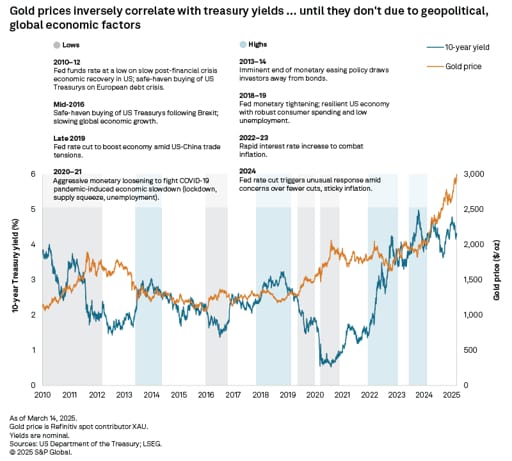
The traditional relationship between gold and interest rates is not completely wrong. It is simply incomplete.
If long-term Treasury yields rise because the economy is strong, inflation is under control, and investors have confidence in the long-term fiscal position of the United States, that is usually a difficult environment for gold. Investors can collect an attractive real yield in government debt without taking on the volatility of a non-yielding asset.
But yields can also rise for less reassuring reasons.
They can rise because investors are worried about persistent inflation. They can rise because the government must issue more debt. And they can rise because buyers demand more compensation to tie up money in 10-, 20-, or 30-year Treasury securities.
That is the difference between a yield rising because of confidence and a yield rising because of concern.
When investors demand more yield because they question future inflation, fiscal discipline, or the sheer scale of government borrowing, the higher yield itself is not necessarily bearish for gold. It may actually be evidence of the risk that gold is designed to hedge.
This is where the conventional gold analysis can miss the point. Looking only at the level of interest rates without asking why they are elevated can lead to the wrong conclusion.
The Debt Problem Is Mathematical

The United States has now crossed $40 trillion in total federal debt. Treasury data reported total public debt outstanding of roughly $40.047 trillion in mid-August, including about $32.266 trillion held by the public.
That number is not just a headline. It creates a structural problem.
As debt increases, the government must refinance maturing obligations and issue new debt to fund ongoing deficits. The more bonds that need to be absorbed by the market, the more important demand becomes. If demand does not keep pace, yields need to rise to attract buyers.
Higher yields then make the problem worse.
Every increase in borrowing costs raises the federal government’s interest expense. Higher interest costs add to future deficits. Larger deficits require even more borrowing. More borrowing can place further upward pressure on long-term yields.
That is the feedback loop:
More debt requires more Treasury issuance.
More issuance can require higher yields.
Higher yields increase federal interest costs.
Higher interest costs worsen future deficits.
Larger deficits lead to even more borrowing.
This does not mean a crisis must happen tomorrow. It means the fiscal math gets harder over time, particularly if economic growth and government revenues fail to keep pace with the debt burden.
The market’s response to this issue is visible in what investors call the term premium. This is the extra return investors demand to hold longer-term bonds instead of repeatedly rolling over short-term debt. If the term premium rises, investors are effectively saying that the future looks less predictable: inflation could be higher, rates could be more volatile, deficits could remain larger, and fiscal policy could become less credible.
That is a very different backdrop than simply saying, “Rates are high, therefore gold should fall.”
Gold Does Not Require a Panicked Fed
Another common assumption is that gold needs the Federal Reserve to slash interest rates before it can perform well.
That is not necessarily true.
If inflation cools and the Fed begins cutting rates, gold could benefit through the traditional mechanism. Lower policy rates can reduce real yields, weaken the dollar, and make a non-yielding asset like gold relatively more attractive.
But there is another scenario.
Inflation could remain sticky. Long-term yields could remain elevated because investors require greater compensation to fund persistent deficits and growing debt issuance. In that environment, the Fed may not be able to cut as aggressively as markets want. Yet gold could still attract demand because investors are not simply hedging inflation—they are hedging uncertainty around the long-term value and credibility of sovereign debt.
This is the key distinction.
Gold is not guaranteed to rise under every possible economic scenario. It can still correct sharply, especially after a major rally. A stronger dollar, easing fiscal concerns, falling inflation, or sustained high real yields driven by genuine economic strength could all pressure the price.
But there may now be more macroeconomic paths that support gold than there were in previous cycles.
Lower rates can support it.
Sticky inflation can support it.
Rising fiscal risk can support it.
A higher term premium can support it.
Growing concern about long-term government debt can support it.
That does not make gold risk-free. It does suggest that the market is no longer driven by one variable alone.
Central Banks Are Still Buying

One of the most important changes in the gold market has been the role of central banks.
Central banks bought 863 tonnes of gold in 2025. That was below the extraordinary pace of the previous several years, but it remained far above the buying levels seen before
More importantly, the trend appears durable. The World Gold Council reported that central-bank demand reached approximately 244 tonnes in the first quarter of 2026, above both the prior quarter and the five-year average. Its 2026 survey also found that 89% of respondents expect global central-bank gold reserves to rise over the following 12 months, while central banks have averaged around 1,000 tonnes of buying annually over the past four years.
Central banks do not buy gold because they are chasing a breakout on a chart.
They hold gold because it is not someone else’s liability. It has no default risk. It is globally recognized, highly liquid, and can serve as a reserve asset outside the banking system and outside the political obligations of another country.
This does not mean gold is replacing the U.S. dollar overnight. The dollar remains central to global trade, reserves, funding, and financial markets. But gold does not need to replace the dollar to see increased demand.
Even a modest shift in reserve allocation—from dollar assets or sovereign bonds toward physical gold—can matter when it comes from buyers with long time horizons and substantial balance sheets.
The Western Buyer May Matter Next
Another reason the gold story may not be finished is that broad Western participation may still have room to increase.
Much of the recent demand has come from central banks, Asian consumers and investors, and structural buyers looking for protection against currency debasement, inflation, or geopolitical uncertainty.
If larger Western asset managers, private wealth accounts, and multi-asset portfolios begin to increase their gold allocations, that could create a second source of demand.
This matters because gold is a relatively small market compared with global stocks, bonds, and sovereign debt. It does not take a dramatic portfolio shift to influence the price. If investors who have spent years underweighting gold decide that fiscal risk deserves a permanent allocation rather than a short-term trade, demand could become more persistent.
That is especially true if investors begin to view gold not as a bet on tomorrow’s Fed meeting, but as insurance against a longer-term trend of excessive debt, larger deficits, financial repression, and declining purchasing power.
Levels to Watch
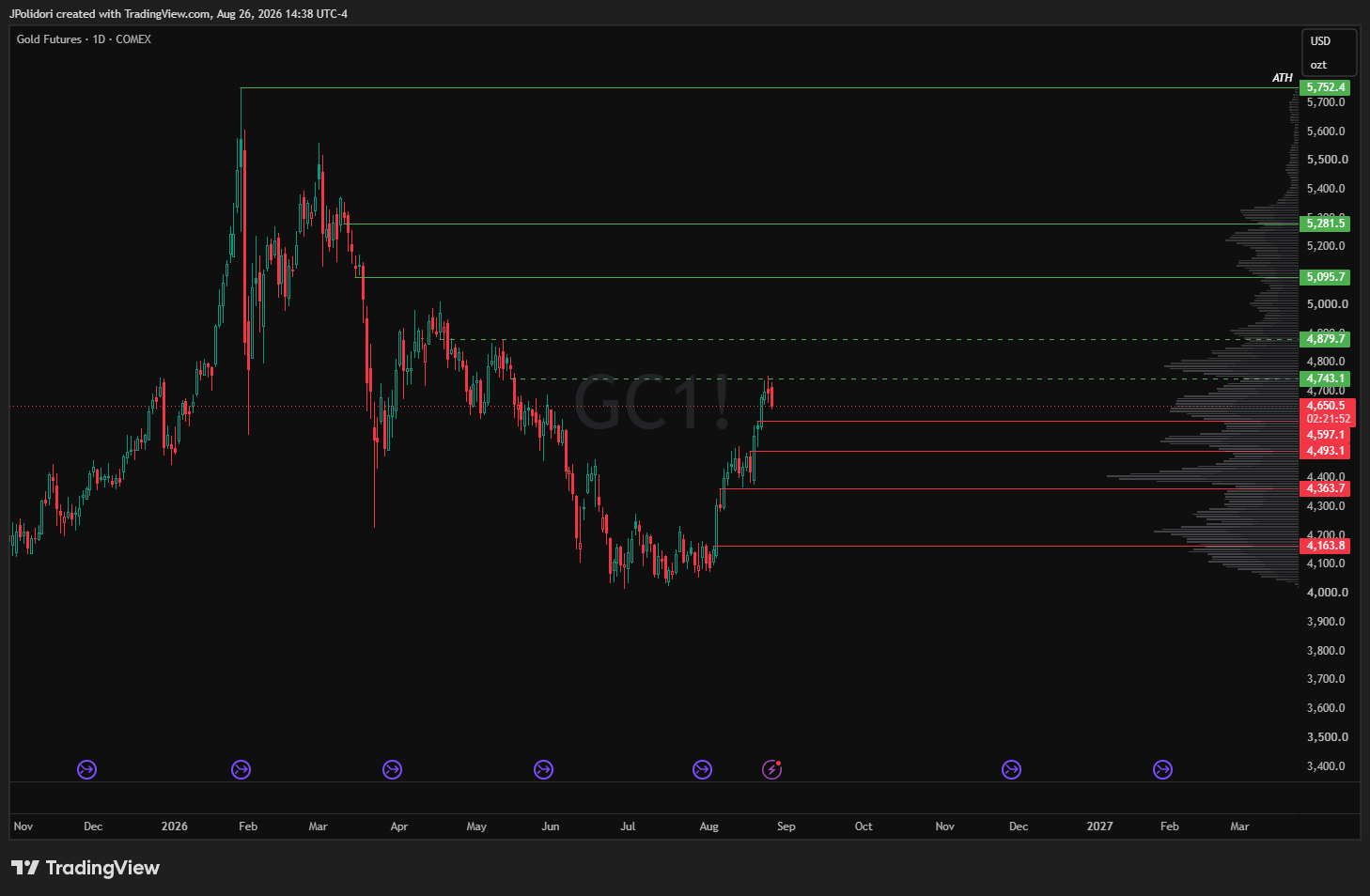
From a technical perspective, the first major zone to watch is roughly $4,700 to $4,800. A strong break above that area could bring $5,000 to $5,100 into focus.
The $5,000 level matters psychologically and technically. If gold can clear it and hold above it, the previous high near $5,600 becomes a realistic level to monitor.
That is not a guarantee. Markets rarely move in straight lines, and gold can be volatile even in a larger bull market. Pullbacks should be expected, especially after fast advances.
Still, a move from around $4,600 to $5,600 would represent roughly a 21% increase. That would be significant, but not unprecedented during major gold bull markets.
The bigger point is this: gold may no longer be responding only to the direction of interest rates.
It may be responding to the reason rates are high in the first place.
If long-term yields are rising because the U.S. fiscal position is becoming harder to finance, then gold’s role expands. It becomes more than an inflation hedge. It becomes a hedge against the choices, tradeoffs, and risks created by a debt-heavy financial system.
That is why, despite a strong rally already, the case for gold may be far from over.
Understand the System. Protect What You've Built. Preserve Your Sovereignty.
Join thousands of readers exploring money, markets, monetary history and sound money.
ABOUT
FREE MINDS.
FREE MARKETS.
SOUND MONEY.


