
When Gold and Yields Rise Together: What the Market May Be Signaling
Gold is holding near $4,400 while long-term Treasury yields are near 5.25%, a combination that challenges the usual “higher rates are bad for gold” story.
The more important question is not whether yields are rising, but why they are rising: if investors are demanding more compensation for inflation, fiscal risk, and long-term currency uncertainty, gold can rise alongside them.
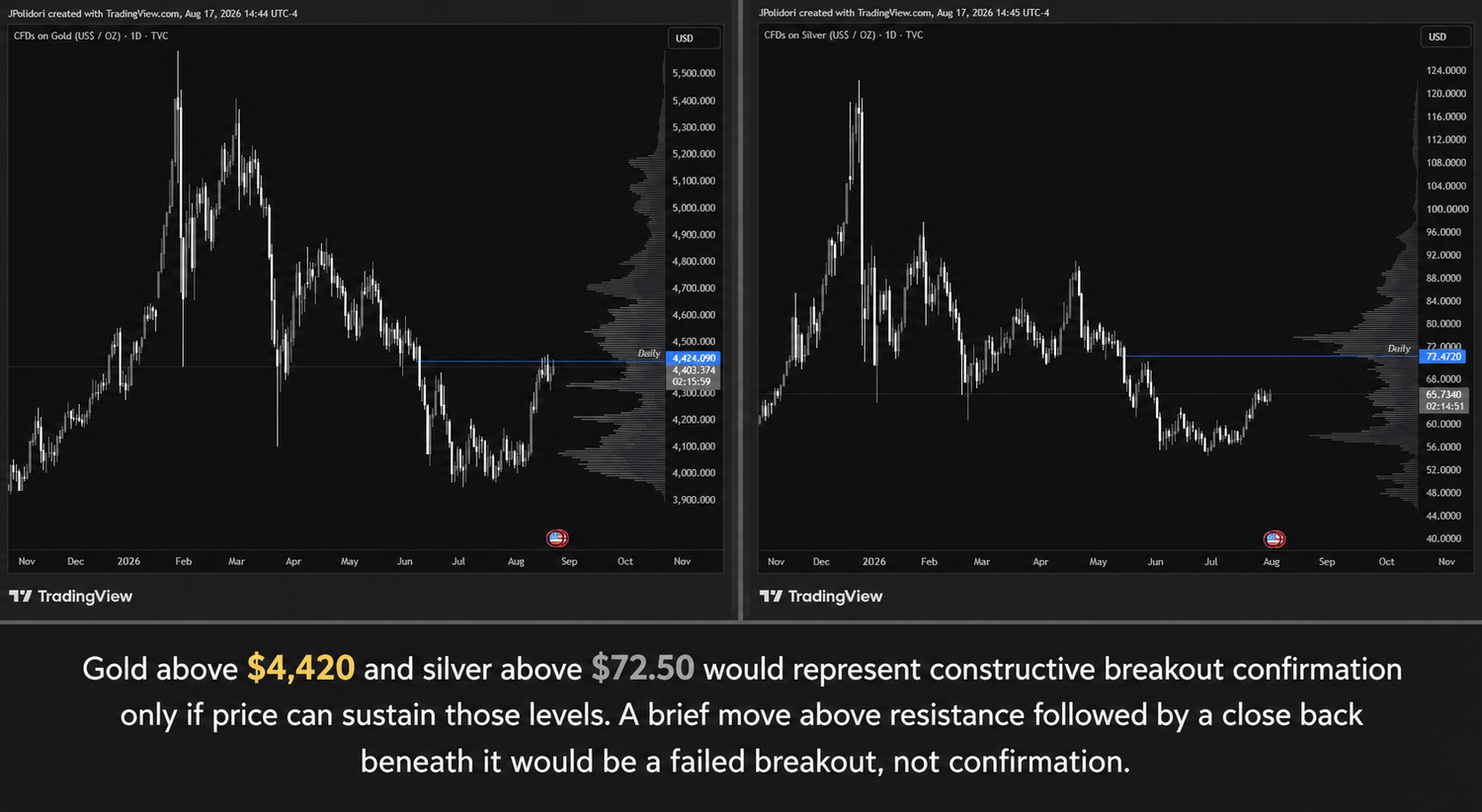
We may also be seeing a technical breakout attempt in both precious metals. For traders watching the chart, a sustained move above $72.50 in silver and above $4,420 in gold would strengthen the case that the next advance is underway.
Those levels are technical reference points, not guarantees and should be watched for confirmation for price acceptance and follow-through rather than a brief intraday spike.
The Old Gold-and-Rates Rule
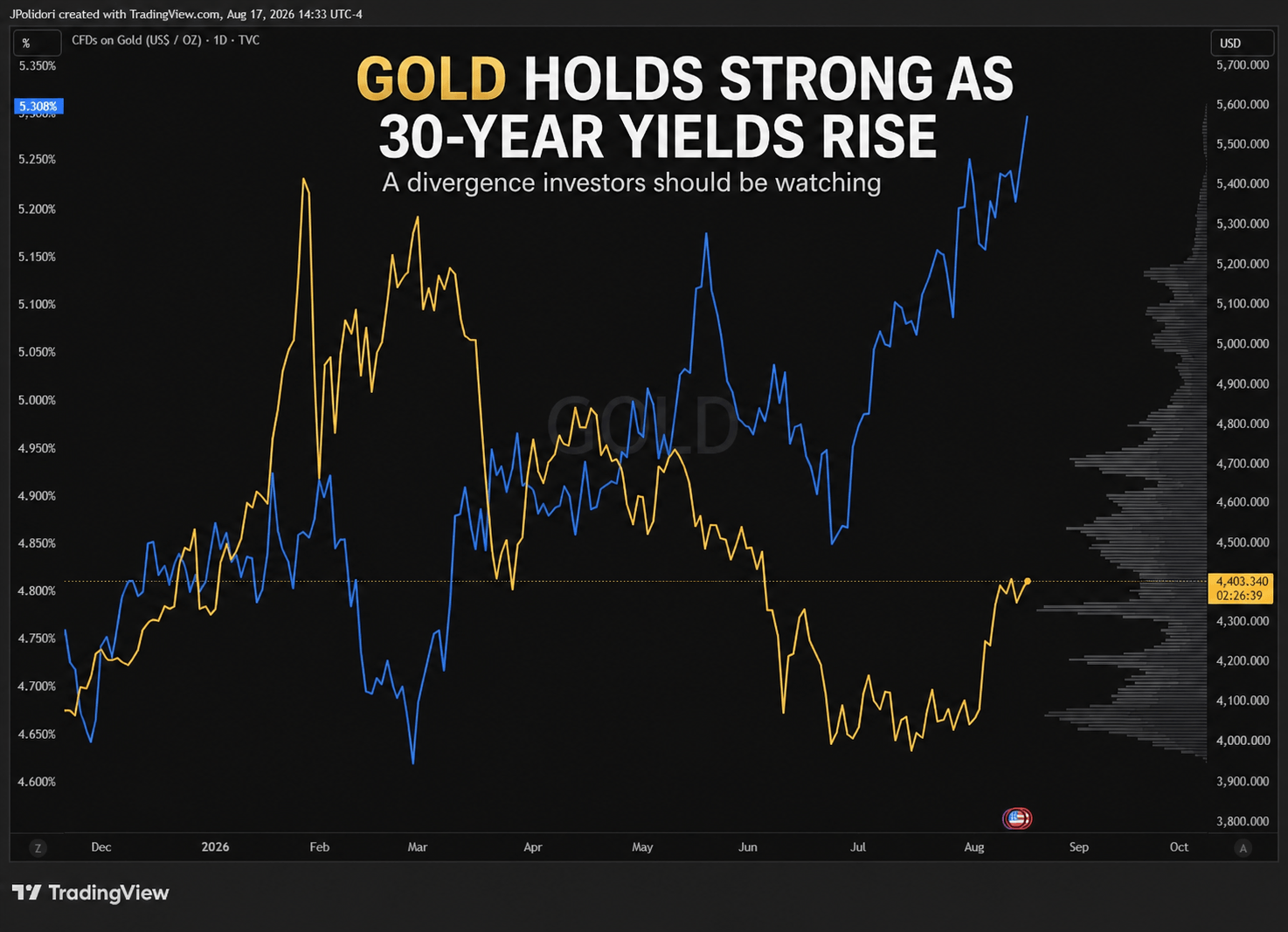
Traditional finance teaches a straightforward relationship: higher interest rates should pressure gold.
Gold does not pay a coupon, dividend, or interest. A Treasury bond does. When yields rise, investors can receive a greater nominal return by holding government debt, raising the opportunity cost of allocating capital to a non-yielding metal. In a normal environment, especially one where yields are rising because real economic growth is strong and monetary policy remains credible, that logic is reasonable.
But market relationships are never laws of physics. A Treasury yield is not a single, simple signal. It includes expectations about future Federal Reserve policy, inflation, economic growth, Treasury issuance, investor demand, foreign capital flows, and the additional compensation investors require for taking long-duration risk—often called the term premium.
That distinction is crucial.
A rise in the 30-year yield driven by accelerating real growth and genuinely positive real returns is one thing. A rise driven by expanding federal deficits, heavy debt issuance, inflation anxiety, and fading confidence in the purchasing power of the dollar is something very different.
Gold does not simply react to a number on a Treasury screen. It reacts to what that number says about the monetary and fiscal system.
What the Long End Is Saying
The U.S. 30-year Treasury yield has been trading around 5.25%, with recent reporting putting it near 5.26%. That is a meaningful level because it represents the market’s required compensation to lend to the U.S. government for three decades.
Treasury prices and yields move in opposite directions. When bond investors sell, Treasury prices fall and yields rise. So, a rising long-term yield can signal that buyers are demanding a larger return before they are willing to absorb the growing supply of federal debt.
The United States faces a basic fiscal challenge: it must continually refinance existing debt while issuing new debt to fund ongoing deficits. If investors become less willing to hold long-dated Treasuries at prior yields, the cost of financing government obligations rises. That does not mean a sovereign default is immediately around the corner. The United States borrows in its own currency and retains substantial monetary capacity. But it does mean the political and economic pressure to suppress borrowing costs becomes greater.
The long end of the curve matters because the Federal Reserve has more direct influence over overnight rates and short-maturity instruments than it does over 10, 20, or 30-year yields. Longer yields reflect the market’s assessment of the future: inflation, deficits, debt issuance, and trust in policymakers’ ability to preserve purchasing power.
Recent market commentary points to a steepening curve in which long-dated yields remain elevated even as expectations for future Fed tightening have eased. That divergence matters. It suggests the bond market may not be focused solely on the next Fed meeting. It may be demanding a larger premium to finance long-term government debt.
Why Gold Can Rise Anyway
The simplistic claim that “higher yields are bullish for the dollar and bearish for gold” misses the real issue: nominal yields are not the same as real yields.
A 5.25% Treasury yield sounds attractive in isolation. But the relevant question for a saver is how much purchasing power remains after inflation. If inflation expectations rise, or if investors expect policymakers to lean toward monetary accommodation to contain government financing costs, then the nominal return on a bond may not provide the protection it appears to offer.
This is where gold becomes relevant.
Gold has historically been viewed as a monetary asset, a store of value, and an asset without counterparty risk. It does not depend on the promise of a government, commercial bank, or corporation to pay. It cannot be created through a keystroke, and it does not carry the credit risk embedded in a bond.
That does not make gold immune to volatility, nor does it mean gold always rises during inflationary periods. It does mean that gold’s role changes when the market begins to question the credibility of long-term fiscal and monetary policy.
The key distinction is between two types of rising-yield environments:
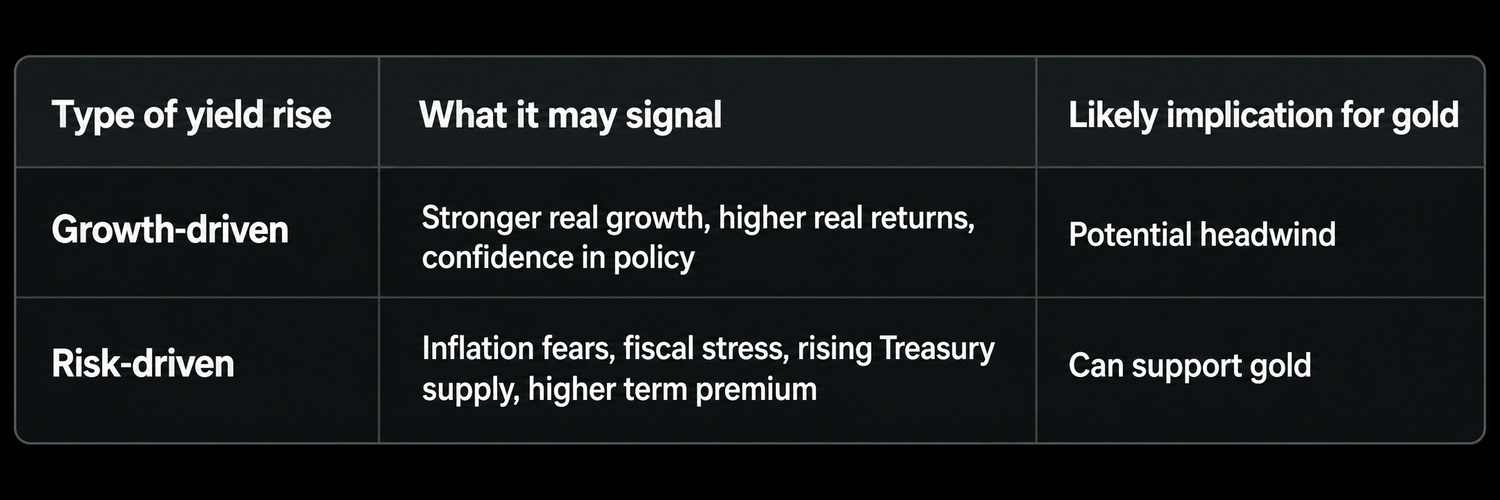
Gold may rise alongside long-term yields when those yields reflect concern about the currency, the fiscal outlook, or the market’s willingness to fund government debt at previous prices.
That appears to be the more important framework today. Gold’s resilience near $4,400 despite elevated long-end yields suggests investors are not viewing the rise in rates as purely healthy, growth-driven strength. Saxo notes that high long-dated yields may increasingly reflect higher term and fiscal risk premiums, while a softer dollar, renewed investment demand, and concerns over fiscal sustainability help underpin gold.
The Central Bank Constraint
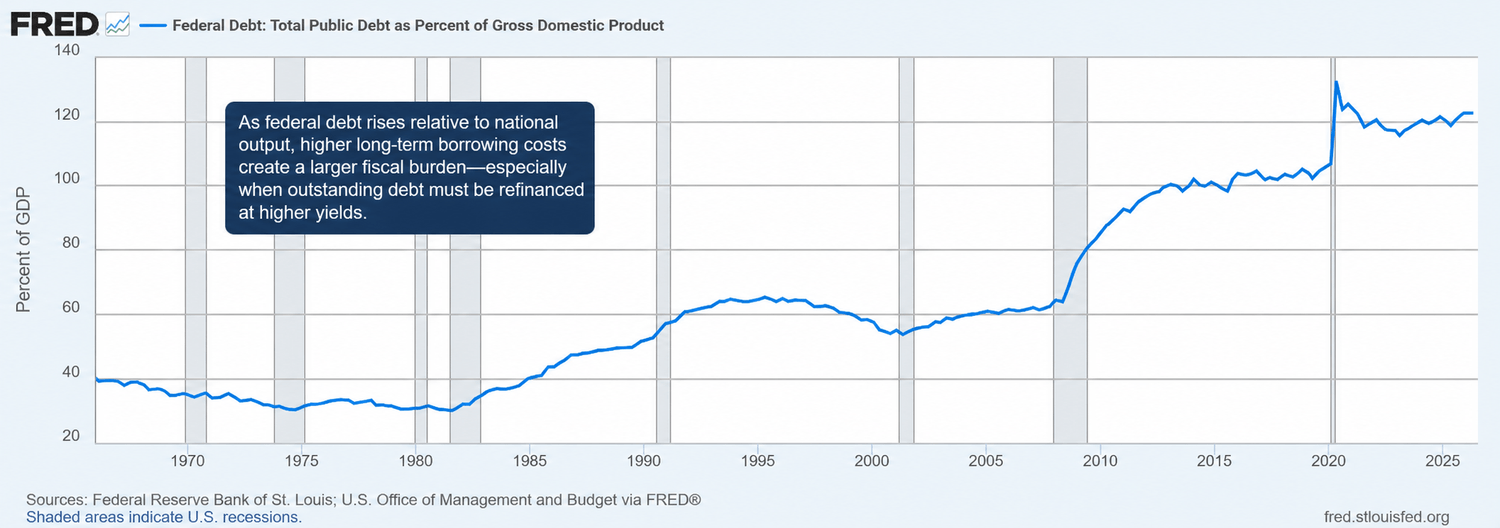
The Federal Reserve faces a difficult balancing act whenever long-term yields rise sharply.
If it keeps policy too tight for too long, it risks intensifying stress across interest-sensitive sectors, including housing, commercial real estate, corporate financing, and government debt service. If it eases aggressively while inflation remains a concern, it risks validating the market’s fear that preserving cheap funding matters more than maintaining sound money.
This is the constraint that many investors are watching.
The word “intervention” does not necessarily mean the Fed will announce an explicit program tomorrow to cap the 30-year yield. But monetary authorities have many ways to affect financial conditions: lowering the policy rate, expanding liquidity facilities, slowing or ending balance-sheet runoff, purchasing securities, influencing bank demand for Treasuries through regulation, or acting when liquidity conditions deteriorate.
The most direct form is yield curve control. Under explicit yield curve control, a central bank commits to buying government bonds in whatever quantity is needed to hold a target yield at a certain maturity. Japan is the modern example most investors think of. The practical purpose is to contain borrowing costs. The tradeoff is that it can blur the line between monetary policy and government debt finance.
Market observers have increasingly discussed the possibility of a less formal version of this process in the United States. Rather than publicly declaring a 30-year yield target, policymakers could respond to stress through rate cuts, liquidity provisions, regulatory incentives for banks to hold Treasuries, or renewed bond purchases.
The Austrian-school concern is straightforward: when governments accumulate debt faster than the economy’s productive capacity can support, policymakers eventually face politically difficult choices. They can accept higher borrowing costs, reduce spending, raise taxes, restructure obligations, or create enough money and credit to make the debt burden easier to carry in nominal terms.
Historically, the temptation is to choose some form of monetary accommodation.
That does not necessarily produce an immediate inflationary explosion. Monetary debasement can emerge gradually—through lower real returns to savers, financial repression, currency depreciation, and a persistent gap between nominal claims and real purchasing power. But gold often begins to price that possibility before it becomes obvious in consumer-price data.
A Warning, Not a Certainty
Investors should be careful not to turn one macro relationship into a certainty.
Gold and silver can decline even when fiscal conditions appear weak. A stronger dollar, rising real yields, forced liquidation, reduced inflation expectations, or a broader liquidity crisis can temporarily pressure metals. Likewise, a 5.25% long-bond yield does not independently prove that the Fed has lost control or that explicit yield curve control is inevitable.
The stronger argument is more measured:
Long-term yields are elevated.
Gold has remained resilient near $4,400 rather than collapsing.
The combination may indicate that the market is pricing fiscal and monetary risks in addition to conventional interest-rate expectations.
If long-term funding stress worsens, the pressure on policymakers to ease financial conditions could grow.
That policy response may reinforce the case for scarce monetary assets.
The market’s message is not necessarily that a crisis has arrived. It may be that investors are demanding more compensation to bear long-term dollar and Treasury risk—and are simultaneously allocating to gold as insurance against the possibility that policymakers ultimately choose easier money over fiscal discipline.
Gold and Silver Technical Setup
Beyond the macro story, price behavior matters.
Gold recently broke higher from a consolidation phase and has held near $4,400, with the $4,500 region identified as an important overhead technical area in one current market assessment. The immediate level to watch is $4,420. If gold can trade above $4,420 and, more importantly, hold above it with sustained buying interest, that would suggest strength and improve the odds that the market is preparing to challenge higher resistance.
Silver often moves with more volatility than gold. It has a dual identity: a monetary metal and an industrial commodity. That can make it more explosive in both directions. A sustained break and hold above $72.50 would be a constructive technical signal, particularly if gold is also confirming its breakout.
“Hold” is the operative word.
A breakout is more credible when price closes above resistance, retests that level without breaking down, and then continues higher. A quick move above a level followed by an immediate collapse below it is not confirmation—it is often a failed breakout or liquidity-driven spike.
For this setup, investors and traders can watch:
Gold above $4,420 with sustained acceptance above that level.
Silver above $72.50 with follow-through rather than a brief breach.
The 30-year Treasury yield and whether it remains elevated or continues climbing.
The U.S. dollar, because a sharp dollar rally could pressure metals.
Real yields and inflation expectations, which provide more context than nominal yields alone.
Any Fed communication that signals a changing tolerance for financial-market stress.
The Bigger Monetary Picture
The simultaneous rise of gold and long-term yields is not a contradiction once we understand what markets are actually pricing.
If yields rise because productivity, growth, and real returns are improving, gold may face a headwind. But if long-term yields rise because investors require more compensation for fiscal deterioration, Treasury supply, inflation risk, and declining confidence in long-term monetary stability, then gold may become more—not less—attractive.
That is the signal investors should study.
The market may be telling us that the cost of funding America’s debt is becoming more difficult to contain without some form of accommodation. Gold near $4,400 while the 30-year yield hovers around 5.25% suggests that investors are not complacent about that possibility.
For now, gold’s $4,420 level and silver’s $72.50 level provide clear technical markers. A decisive move above, followed by sustained holding action, would add confirmation to the broader macro thesis: that investors are increasingly positioning for a world in which long-term debt stress, monetary intervention, and the erosion of purchasing power become central market themes.
Nothing in markets is guaranteed. But when the long bond sells off and gold refuses to fall, it is worth paying attention.
Understand the System. Protect What You've Built. Preserve Your Sovereignty.
Join thousands of readers exploring money, markets, monetary history and sound money.
ABOUT
FREE MINDS.
FREE MARKETS.
SOUND MONEY.


