
The Warmth of Collectivism Has a Body Count: Mamdani and the Old Lie Rebranded
“Individual rights are not subject to a public vote; a majority has no right to vote away the rights of a minority; the political function of rights is precisely to protect minorities from oppression by majorities (and the smallest minority on earth is the individual).”
— Ayn Rand
When Zohran Mamdani argues that society must abandon the “rigidity of individualism” in favor of the “warmth of collectivism,” he’s repeating the same rhetoric that has been used in the past to persuade those who lack understanding of how human nature/action is the main driver of economics. An idea that has failed every time it has been tried: he treats individual rights as an obstacle to compassion rather than the precondition for it.
I imagine he was a “privileged” little boy after his parents left Uganda, an authoritarian regime and found success in the United States. His mother became a successful film director and his father a professor at Columbia. Millionaires by definition. Now he wants to change the system for the rest of us.
As Ayn Rand warned in Atlas Shrugged, once individual rights are subordinated to collective goals, there is no neutral mechanism left to decide whose needs matter, only political power. Collectivism doesn’t magically erase self-interest; it transfers it from individuals operating under voluntary exchange to institutions operating through coercion. What is framed as “warmth” quickly becomes permission, compliance, and enforcement, because a society that denies the individual the right to live for his own sake must empower someone else to decide how his life is used. History shows this is grave error and always ends with authoritarian control.
Rand understood what modern collectivists, or as they call themselves “democratic socialists’, refuse to acknowledge: once individual rights are denied, authority must step in to manage the chaos. The individual is the smallest minority, and when his or her rights are put aside for the good of the “the collective,” there is no protection left against power. Collectivism cannot remain humane because it has no stopping point, only expanding control.
Once individuals lose the right to say no, someone must be given the power to force a yes.
Self-interest is often mislabeled as greed, but the two are not the same. Self-interest is the drive to improve one’s condition through effort, creativity, and personal responsibility. It is the reason people take risks, build businesses, acquire skills, and solve problems without being ordered to do so. When properly channeled through voluntary exchange, self-interest becomes the engine of innovation and rising living standards. When suppressed, it does not disappear it simply is transferred from all individuals acting out of free will and concentrated in the hands of those who seek power and control.
This is the philosophical foundation Ayn Rand articulated in Atlas Shrugged: man is an end in himself, not a means to the ends of others. A society that treats individuals as instruments to be managed in service of “the collective” ultimately destroys the very source of its productivity, creativity, and moral agency. You cannot build a prosperous civilization by demanding sacrifice as a permanent obligation. You can only build it by respecting the individual as the smallest and most essential minorit

Collectivism vs. Human Nature: The Fatal Conflict
Collectivism presents itself as morally superior to reality, as if human nature were an inconvenience that could be corrected with enough policy, education, or good intentions. Socialism and communism require the suppression of ambition, the elevation of obligation over choice, and the punishment of excellence whenever it produces unequal outcomes. This has failed everywhere it has been tried yet its appeal has not diminished; it has only encouraged its advocates to insist that the next attempt will finally get human nature to cooperate.
At the center of this worldview is what Ayn Rand described as the morality of sacrifice: the idea that virtue consists of placing others above oneself as a permanent duty, enforced not by conscience but by policy. Under this moral inversion, success becomes demonized and productivity becomes something the state feels entitled to manage. The individual is no longer a moral agent, but a unit useful only insofar as he serves a collective purpose defined by people who do not share the consequences of their decisions.
The results are so consistent they border on parody. When ambition is suppressed, stagnation follows. When prices are detached from reality, shortages emerge. When voluntary exchange is restricted, black markets appear not because people are greedy, but because reality does not obey ideology. And when persuasion fails, enforcement fills the gap. Every collectivist system eventually confronts the same problem: people refuse to behave like abstractions.
Yet rather than abandon the premise, collectivist regimes double down on control. I recently watched a video of Mamdani’s “Tenant director of individual home ownership” stating “people are going to have to change their relationship with property”. What??? I think maybe they should change their relationship with reality. They expand bureaucracy, criminalize dissent, and moralize coercion, all while insisting the system is compassionate. The rhetoric remains warm; the apparatus grows colder. A system that must be enforced at the point of a gun is not morally superior.
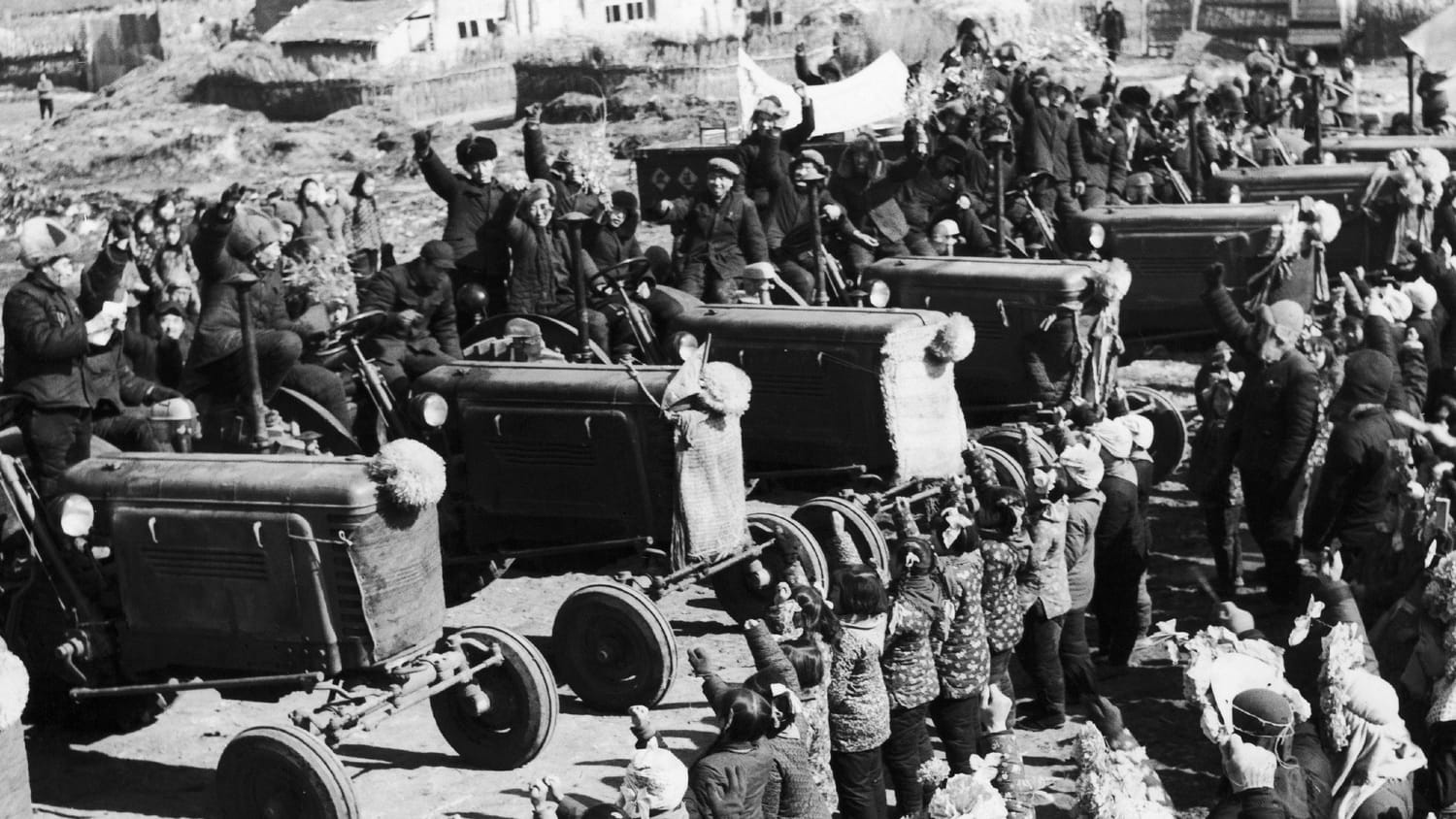
(Image showing forced starvations during the “Great Leap Forward”. It’s estimated that 30-45 million people died during this time)
History’s Verdict: Collectivism’s Body Count
History has already run this experiment. Repeatedly. At scale. With catastrophic consistency. The only thing that changes from one iteration to the next is the excuse for ignoring the results. In the Soviet Union, collectivization of agriculture and industry was justified as scientific planning. In practice, it meant quotas replacing prices, ideology replacing feedback, and obedience replacing competence. Farmers who produced “too much” were labeled:” kulaks”. These were simply peasant’s wealthy enough to own a farm and hire labor who resisted Stalin’s forced collectivism but most of them were exiled, arrested or killed. Tens of millions died through famine, forced labor, and purges not because the system malfunctioned, but because it functioned exactly as designed: by criminalizing independent action and enforcing compliance through terror.
In China under Mao Zedong, the timeline was even more revealing. The Great Leap Forward, a line repeated by Kamala Harris on the campaign trail for the last election, collapsed almost immediately. Within a few years, tens of millions were dead from starvation as collectivized farms destroyed incentives to grow food and local officials falsified output to appease central planners. Reality contradicted doctrine, so reality was punished. The lesson was not learned. It was denied followed by the Cultural Revolution, where productivity, education, and expertise themselves were treated as moral threats. When ideology demands obedience over truth, collapse is not a possibility; it is inevitable.
And for those who insist these are relics of the past, Venezuela offers a contemporary reminder. Resource-rich, oil-abundant, and prosperous by regional standards, Venezuela adopted collectivist controls in the name of social justice. Price controls destroyed production. Nationalization hollowed out industry. Currency debasement erased savings. Today, shortages, mass emigration, and institutional collapse are explained once again as the result of sanctions, bad luck, or insufficient commitment to the ideology. Never the ideology itself. In the wake of current events, I will preface this by saying, I am not an interventionist by nature. I prefer we stay out of geopolitical affairs unless it directly influences us. There are many ways this could potentially impact the U.S. with the powers that have taken interest and become allies with Maduro. But seeing the response from some of the “collectivist” in American politics even after seeing the citizens of Venezuela who seem to be very happy about the results. I find it comical. Living in South Florida I have had many conversations with both Venezuelans and Cubans who fled to come here because of the disastrous results and corruption.
Millions did not die by accident. They died because individual incentives were destroyed. Ayn Rand warns in Atlas Shrugged, when productivity is criminalized, survival itself becomes illegal. The only truly astonishing thing is that, after a century of evidence written in mass graves, there are people that still believe, this time will be different.
Why Capitalism Works Because Humans Are Self-Interested
Capitalism works not because humans are angels, but because it makes no such assumption. It begins with reality: people act in their own interest, respond to incentives, and differ widely in talent, ambition, and risk tolerance. Rather than attempting to suppress these traits, capitalism channels them. It allows individuals to pursue their own advancement through voluntary exchange, and in doing so, align private ambition with public benefit.
The American experience makes this unmistakable. At the founding of the United States, the overwhelming majority of the population lived at or near subsistence levels by modern standards. Over the next two centuries despite wars, depressions, political corruption, and the eventual creation of a central bank explicitly opposed by many of the Founders, living standards rose dramatically. Extreme poverty, once the default condition of humanity, collapsed. Child labor disappeared not by decree but by productivity. Life expectancy more than doubled. Access to food, energy, housing, transportation, and technology expanded beyond what even elites could imagine in prior centuries. This was not achieved through centralized compassion, but through decentralized production.
Capitalism accomplishes this because profit functions as a signal, not a sin. Profit tells society what is scarce, what is valued, and what is being done efficiently. Losses perform the equally important function of signaling waste. Together, they form a feedback system no Credentialed Non-Producers can replicate. Entrepreneurs risk their own capital to solve problems they are not legally obligated to solve. Innovation emerges not from moral exhortation, but from incentive alignment. Jobs are created not by mandates, but by demand. Standards of living rise not because wealth is redistributed, but because it is first created.
This stands in direct contrast to collectivist systems, which rely on forced redistribution rather than voluntary exchange. Where capitalism asks, “What can I offer that others will freely choose?” collectivism asks, “What can be taken, and who will enforce it?” The former requires creativity, accountability, and adaptation. The latter requires authority, compliance, and punishment. One scales prosperity, the other scales control.
Again, Ayn Rand captured this distinction with brutal clarity in Atlas Shrugged. Her central insight was not that capitalism produces wealth, but that it depends on the minds willing to produce it. When those minds are vilified, regulated, and treated as moral debtors rather than value creators, they withdraw not out of spite, but self-preservation. And when the men and women of the mind stop building, the system that feeds on their output collapses under its own weight.
Capitalism is not perfect, nor has it ever existed in its pure form, especially after the rise of central banking and monetary manipulation. But even in its compromised state, it has proven to be the single greatest engine for broad-based human flourishing the world has ever known. The lesson of history is not that capitalism failed to deliver utopia. It is that every attempt to replace it with coercion has delivered catastrophe instead.
Atlas Is Shrugging Again
Mamdani’s election could signal a turning point in the ideology that built the most prosperous nation ever to exist. This is where Atlas Shrugged stops being literature and starts becoming diagnosis. Rand’s question was never abstract. It was simple and brutally practical: Who carries the world—and what happens when they stop? Not the slogans. Not the“Credentialed non producers”. Not the politicians. The ones who build and drive society forward.
Today, those same people are blamed for problems they did not cause. “The rich” are cast as villains, while the very political class that engineered inflation, debt, and the continuing widening of the wealth gap, are asking us to “just trust them”, they will fix everything.
Until next time. Free minds. Free markets. Sound money.
Understand the System. Protect What You've Built. Preserve Your Sovereignty.
Join thousands of readers exploring money, markets, monetary history and sound money.
ABOUT
FREE MINDS.
FREE MARKETS.
SOUND MONEY.


