
The Bond Vigilantes Are Back—and They Are Forcing America Toward Yield Curve Control
The bond market is demanding a higher return to finance America’s deficit-and-debt machine. Washington cannot tolerate that signal indefinitely. Treasury buybacks are the opening maneuver; a Federal Reserve backstop is the endgame.
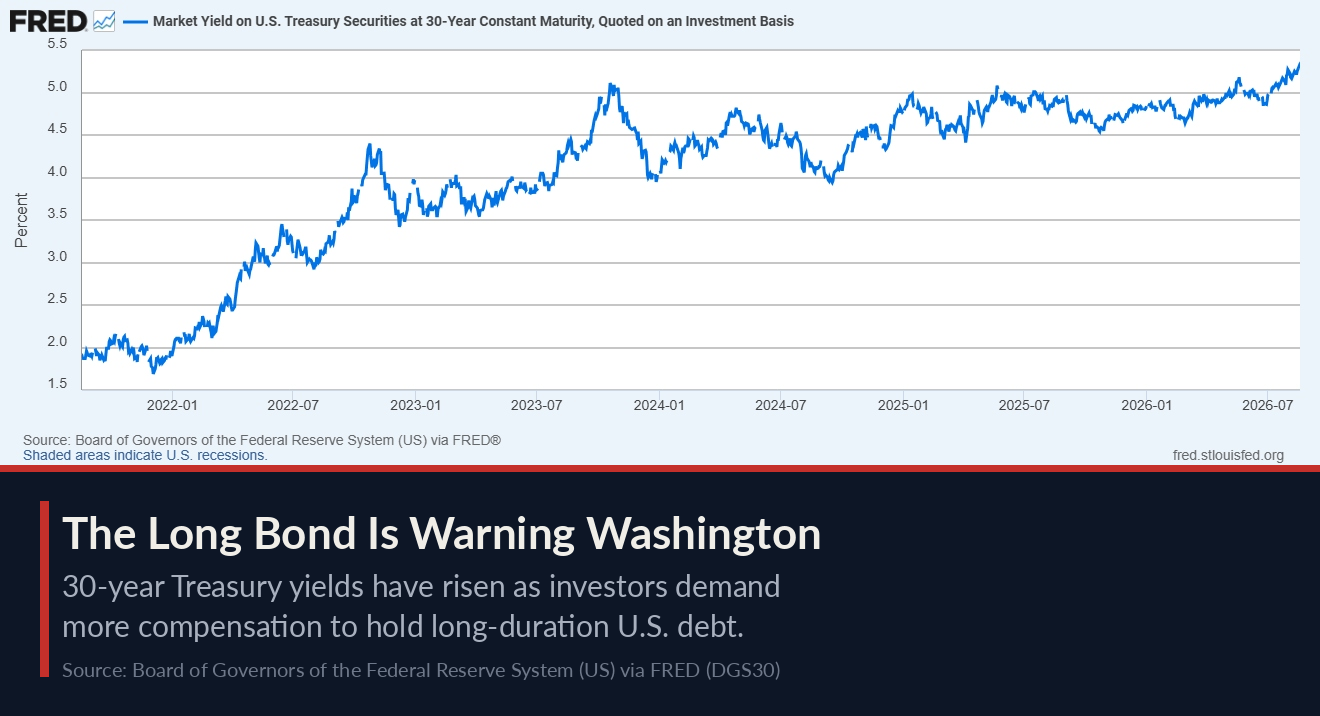
The 30-year Treasury yield pushes above 5.3%. Within hours, the Treasury Department expands purchases of long-dated government debt. Yields fall.
Then comes the official reassurance: this is merely liquidity management. It is not meant to alleviate market stress.
Markets are not fooled by labels.
When investors begin demanding a higher return to lend money to the U.S. government for 10, 20, or 30 years, Washington has a problem that no press release can solve. Higher long-term rates do not merely hurt stocks, housing, and corporate borrowing. They threaten the fiscal foundation of a government that has accumulated so much debt that it increasingly cannot tolerate a genuinely free bond market.
Treasury’s latest move made that reality impossible to ignore. The 30-year yield had climbed to roughly 5.33%, its highest level since 2007. Treasury then said it would at least double longer-duration buyback operations, from a prior $2 billion maximum to at least $4 billion per operation from September through early November. The market reaction was immediate: the 10-year yield fell 6 basis points to 4.647%, while the 30-year yield fell 9 basis points to 5.196%.
The immediate question is not whether $4 billion in buybacks can solve a multi-trillion-dollar fiscal problem. It cannot.
The real question is what this tells us about the system’s tolerance for market-set long-term interest rates.
America cannot absorb higher rates
The fiscal danger is not simply that the United States has a large national debt. The danger is the feedback loop created when an overindebted government must continuously refinance old debt and issue new debt at higher rates.
The federal government does not have one fixed-rate mortgage locked in for 30 years. Treasury securities mature constantly. Bills roll over within months. Notes and bonds mature over years. As they mature, Treasury must refinance them at the rates the market demands at that moment.
That is where the trap begins.
When yields rise, every refinancing cycle becomes more expensive. Interest expense rises. The deficit widens. The Treasury must issue more debt to cover the wider deficit. Investors see more supply, more inflation risk, more fiscal risk, and more duration risk. They demand still-higher yields to absorb it.
The cycle looks like this:
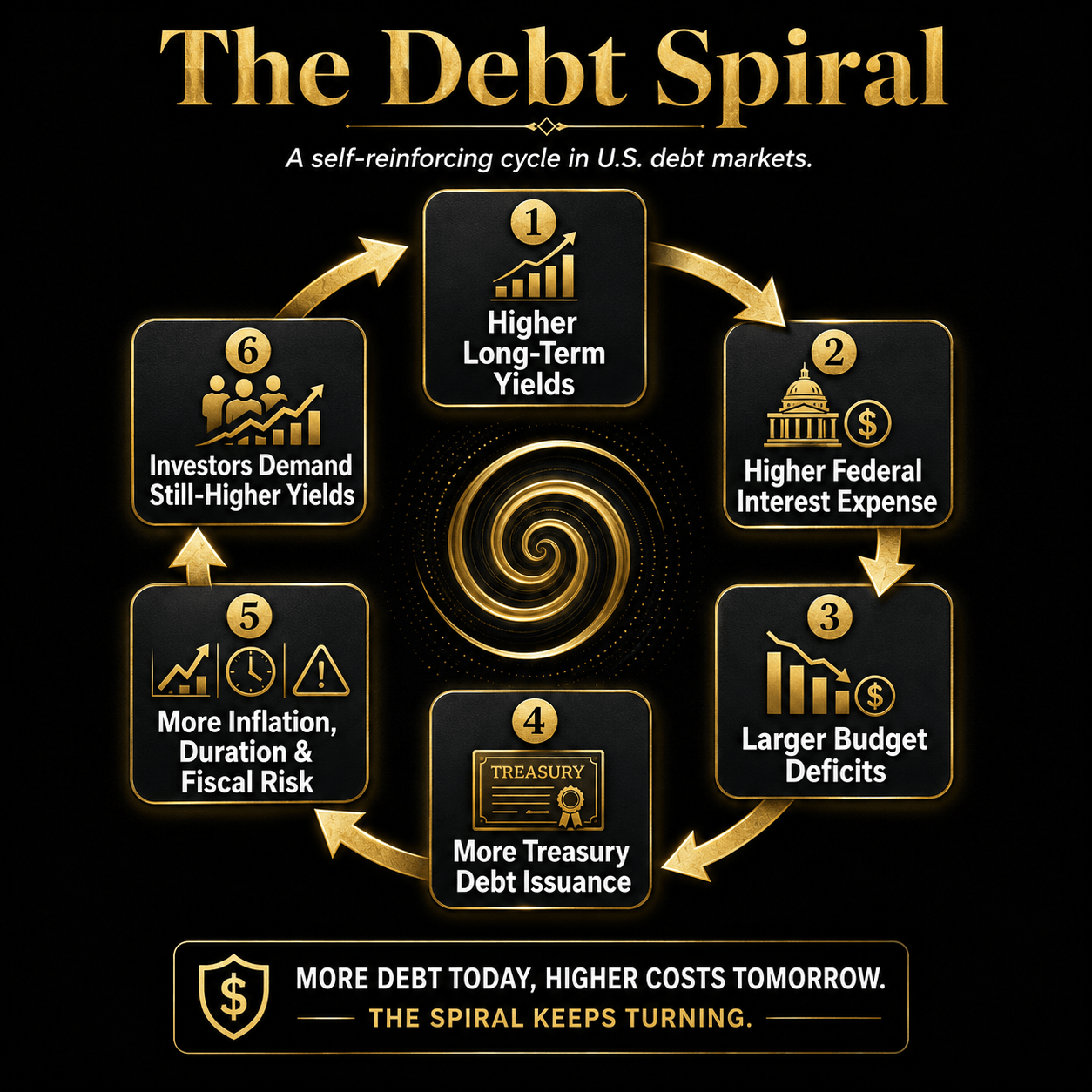
At sufficiently high rates, deficits do not merely reflect past political decisions. Interest
expense becomes a machine that generates fresh deficits, which require fresh borrowing, which invites higher yields.
That is the debt spiral.
Treasury’s own financing calendar shows the scale of the machine. In its August quarterly refunding, Treasury offered $125 billion in securities to refinance about $96.3 billion of maturing privately held notes and bonds while raising roughly $28.7 billion in new cash. That included a $25 billion 30-year bond offering.
At the same time, Treasury planned up to $38 billion in purchases of off-the-run securities for liquidity support and up to $25 billion in purchases of one-month to two-year securities for cash management over the quarter.
Those buybacks may matter for the liquidity and structure of specific Treasury issues. But look at the larger picture: the federal financing machine is so large that billions in buybacks are a tactical maneuver within a vastly larger issuance and rollover operation.
And higher rates do not stay contained inside Washington. They flow into mortgage rates, auto loans, consumer credit, commercial real estate, corporate refinancing, bank balance sheets, and equity valuations. But the central issue remains the government’s own interest bill.
The United States can survive a temporary rise in rates. What it cannot comfortably absorb is a sustained period in which the market demands significantly higher yields while Treasury must roll over and expand a massive debt stock.
The return of bond vigilantes
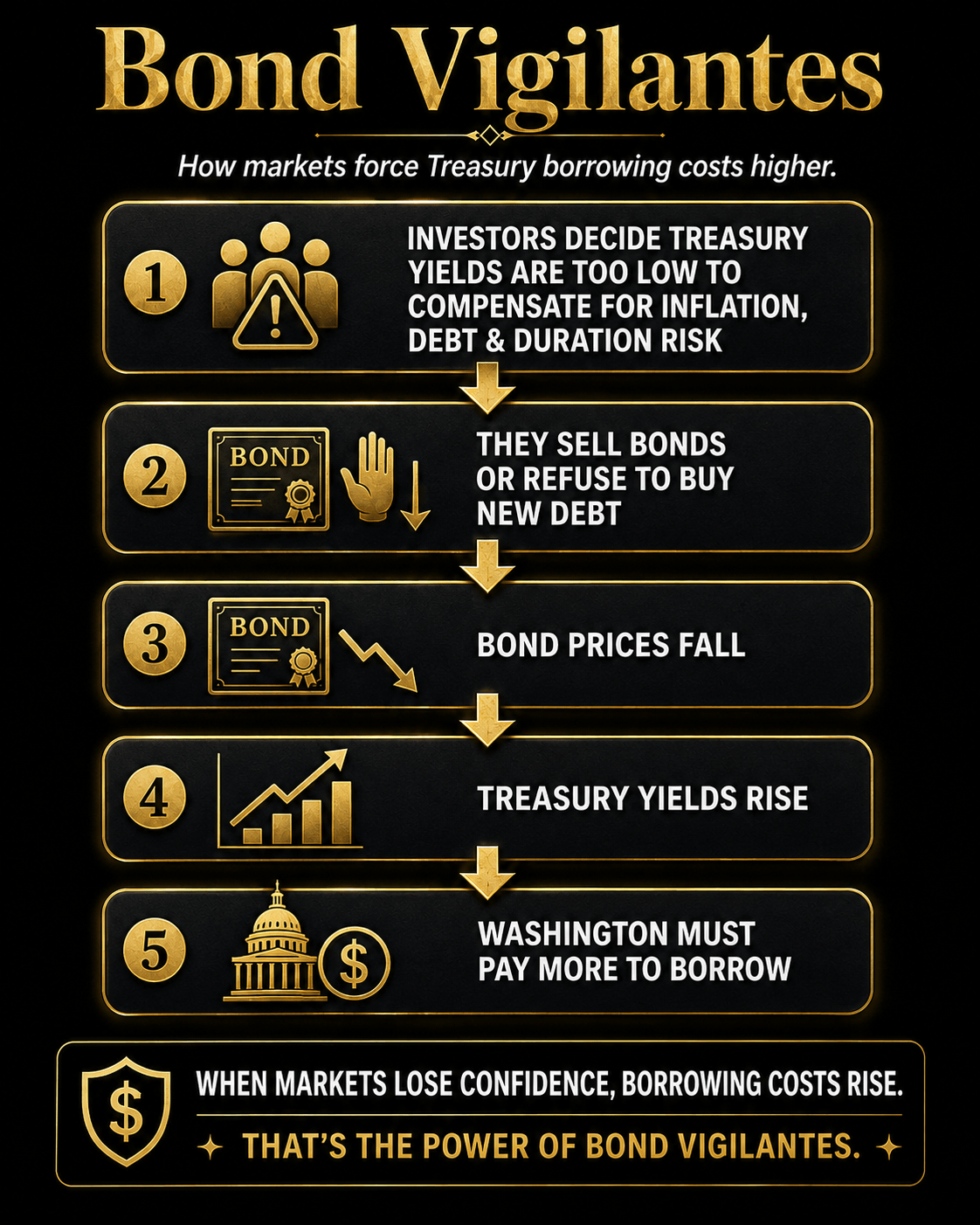
This is where the bond vigilantes come in.
“Bond vigilantes” is not the name of a secret organization. It is a market term for investors who impose discipline on governments that borrow, spend, or inflate beyond what lenders are willing to finance at existing yields.
They include asset managers, pension funds, insurers, hedge funds, banks, foreign reserve managers, and individual investors. They do not need to coordinate. They simply respond to risk.
If investors conclude that Treasury yields no longer compensate them for inflation, duration, fiscal instability, and the flood of new supply, they sell bonds or decline to buy new issuance at prevailing yields. Bond prices fall. Since bond prices and yields move inversely, yields rise. Treasury then has to offer a higher return to attract buyers and clear its auctions.
That is the bond market’s version of a vote of no confidence.
Bond vigilantes are not “attacking America.” They are not enemies of the country. They are refusing to subsidize fiscal indiscipline at yields that no longer compensate them for the risks involved.
They are not demanding higher yields because they hate the United States. They are demanding higher yields because they can read a balance sheet—and they know a debt spiral when they see one.
For years, Washington has benefited from a world willing to treat Treasury debt as the ultimate safe asset. That status is powerful. It does not mean investors will lend at any price, under any fiscal condition, for any length of time.
A bond investor considering a 30-year Treasury is not only asking what the Federal Reserve will do next month. He is asking what inflation could look like over decades, how much debt Washington will issue, whether foreign demand remains reliable, and whether future policymakers will choose fiscal reform or monetary debasement.
When enough investors demand a larger premium for those risks, the long end of the yield curve begins to rise regardless of the Fed’s short-term policy rate.
That is precisely why a free bond market becomes intolerable to an overleveraged government.
Buybacks are yield suppression—not YCC
Treasury buybacks are not formal Yield Curve Control. That distinction matters.
Formal YCC occurs when a central bank commits to hold a specific Treasury yield at or below a stated level and purchases whatever quantity of debt is necessary to enforce that target. The Bank of Japan is the modern example. The United States itself used a form of yield pegging during World War II and the early postwar period.
What Treasury is doing today is more limited. It is repurchasing selected securities, generally while issuing other debt. It is scheduled, maturity-specific, and capped by an announced size. It can improve liquidity in older, less actively traded “off-the-run” bonds and influence the maturity composition of outstanding government debt.
That is not the same thing as the Fed announcing, “The 10-year yield will not exceed 4%,” and printing reserves to enforce the ceiling.
But it belongs to the same family of policies: interventions designed to make the government’s cost of capital lower than a free market may otherwise demand.
Treasury can call it liquidity support. It can call it debt management. It can call it cash management. But the political message is clear: Washington is watching the long end of the curve, and it is prepared to act when long-term borrowing costs rise too far.
Treasury’s quarterly plan explicitly frames up to $38 billion of off-the-run security purchases as liquidity support and up to $25 billion in shorter-maturity purchases as cash management. Those descriptions may be technically accurate. They do not change the economic incentive.
Buybacks cannot extinguish the fiscal problem because Treasury cannot buy debt without financing the operation somehow. It can retire a 30-year bond and issue bills. It can shift the maturity profile. It can improve liquidity in particular issues. But it has not made the government less indebted.
It has moved the risk around the curve and postponed the confrontation with the market.
In fact, leaning more heavily on bills and short-term financing may make the system more vulnerable. Shorter-term debt must be refinanced more frequently. That reduces today’s long-end borrowing pressure, but it increases the sensitivity of the federal budget to short-term interest rates tomorrow.
It buys time, not solvency.
And once Treasury debt management tactics are no longer enough to contain yields, the institution with the balance sheet capable of imposing a ceiling is not Treasury.
It is the Federal Reserve.
Gold and Silver Heard the Signal
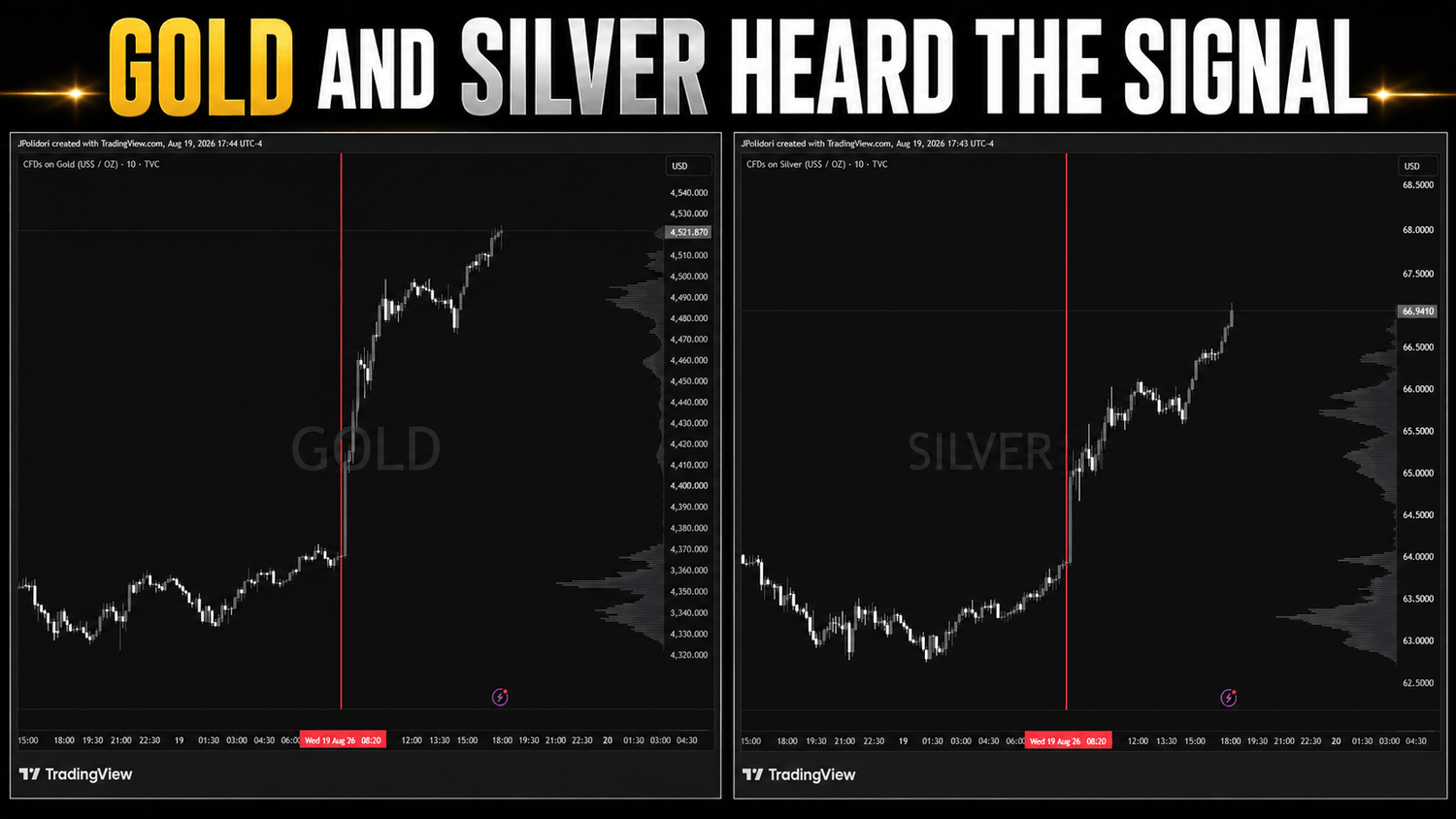
The market’s response was not limited to Treasury bonds.
By the end of the trading day, gold had surged 4.35%, closing at $4,521.87 per ounce. Silver rose an even more violent 5.73%, finishing at $66.941 per ounce.
That does not mean every dollar of the move came from one Treasury announcement. Precious metals also react to geopolitical risk, inflation expectations, central-bank policy, dollar strength, and positioning.
But the direction and timing matter.
The long bond surged above 5.3%. Treasury then announced it would at least double buybacks of longer-dated government debt. Yields fell, the dollar weakened, and gold and silver exploded higher. Treasury said the operation was about liquidity management. The metals market heard something different: Washington is prepared to intervene when the bond market demands a borrowing cost the fiscal system cannot tolerate.
Gold and silver are not rallying because Treasury solved the debt problem. Treasury cannot solve a multi-trillion-dollar financing problem by buying a few billion dollars of selected bonds.
They are rallying because the market sees the direction of travel: suppress the long end, protect the government’s financing costs, and if Treasury’s debt-management maneuvers fail, bring in the Federal Reserve to do what only a central bank can do.
That is why monetary metals matter. They are not a promise from the government that issued too much debt. They are an alternative to that promise.
Why the Fed gets pulled in
The Fed will insist, correctly in a narrow legal sense that it is independent and focused on price stability and employment. But formal independence does not erase political and financial reality.
When Treasury-market disorder threatens federal financing, credit markets, bank balance sheets, housing, and financial stability at the same time, the pressure for intervention becomes overwhelming.
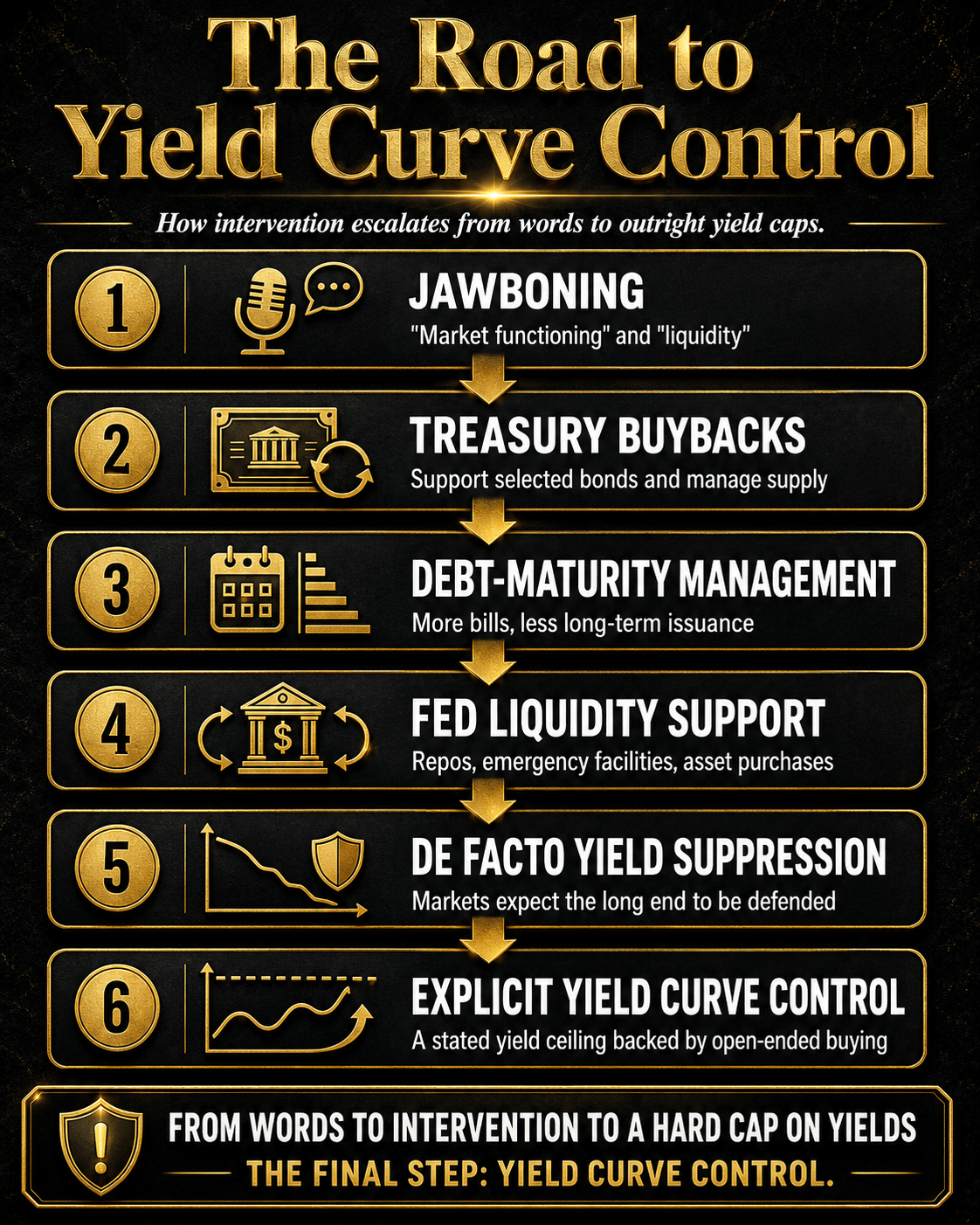
The progression is predictable.
First comes jawboning. Officials begin talking about “market functioning,” “liquidity,” “volatility,” or “disorderly conditions.”
Then come Treasury operations: buybacks, changes in issuance composition, more bill financing, and deliberate efforts to manage long-end supply.
Next comes institutional pressure. Regulations, capital rules, and incentives can nudge banks, insurers, pension funds, and other regulated institutions toward holding government debt.
Then comes Fed support: repo facilities, emergency liquidity programs, and asset purchases justified as preserving market function rather than financing the Treasury.
Finally, explicit or implicit YCC arrives. It may not carry that label. The Fed may never announce a clean numerical ceiling. But if market participants know that the central bank will buy enough Treasuries whenever yields cross a politically intolerable threshold, the effect is a yield cap whether officials use the phrase or not.
America has been here before. During World War II and into the postwar period, the Federal Reserve helped support Treasury financing by pegging parts of the yield curve. Long-term Treasury yields were held at 2.5% until the 1951 Treasury-Fed Accord ended the Fed’s obligation to support government debt at fixed rates.
The lesson is not that the United States will repeat the policy with the same number, the same language, or the same institutional arrangement.
The lesson is that, under fiscal pressure, central-bank independence becomes less important than the government’s ability to finance itself.
The Fed will not need to wake up one morning and “choose” YCC as an abstract policy preference. If Washington refuses to reform its fiscal position, the Fed will increasingly face a choice between allowing a disorderly repricing of government debt—or becoming the buyer that prevents it.
That is fiscal dominance.
Intervention can cap nominal yields. It cannot manufacture real savings. It cannot erase debt. It cannot make an indebted government solvent. It can only transfer the cost from visible interest rates to hidden forms of taxation: currency debasement, distorted capital allocation, negative real returns, and inflation.
The endgame is financial repression
When governments cannot afford market interest rates and refuse to accept fiscal restraint, they move toward financial repression.
Financial repression is the process of channeling savings into government debt and holding borrowing costs below what an unconstrained market would demand. It can take many forms: central-bank bond purchases, capped yields, regulations that favor sovereign debt on institutional balance sheets, inflation that erodes the real value of debt, or restrictions that make it harder for savers to escape the domestic financial system.
The objective is not necessarily zero nominal rates.
The political objective is negative real financing costs: letting inflation run above the yield paid to creditors, thereby reducing the debt burden in purchasing-power terms.
That is why gold and silver remain relevant. They are not a promise from the fiscal authority. They do not depend on Washington’s ability to refinance debt, raise taxes, preserve purchasing power, or maintain confidence in the dollar.
They are alternatives to the promise.
The bond vigilantes are sending a signal: America’s fiscal trajectory requires a higher price for capital. Treasury’s response is to reduce that signal through buybacks. The next steps will be described as liquidity support, market functioning, or financial stability.
But the underlying conflict will remain unchanged.
A government that cannot endure honest interest rates will attempt to control them.
The question is not whether this administration eventually uses the official phrase “Yield Curve Control.” The question is whether the Federal Reserve becomes the buyer of last resort for a government that has grown too indebted to finance itself in a genuinely free market.
The debt spiral does not end when yields are suppressed. It simply becomes harder to see—until it reappears as inflation, currency weakness, and the loss of monetary credibility.
Subscribe to Sound and Sovereign for weekly research on the debt spiral, monetary debasement, precious metals, and the policies governments turn to when the bond market stops cooperating.
Understand the System. Protect What You've Built. Preserve Your Sovereignty.
Join thousands of readers exploring money, markets, monetary history and sound money.
ABOUT
FREE MINDS.
FREE MARKETS.
SOUND MONEY.


