The Confidence Game: How We Went From Sound Money to Fiat Currency
If you study monetary history long enough, you begin noticing an uncomfortable pattern.
Governments build prosperous economies. Prosperity leads to greater spending and political ambition. Debt rises. Wars and entitlement programs become increasingly expensive. Eventually, maintaining those promises becomes more important than maintaining the integrity of the currency.
So the currency gets debased.
Sometimes that meant reducing the amount of gold or silver inside a coin.
Today, it means creating more currency and credit.
The technology has changed.
Human nature has not.
And understanding that history matters because most of us spend our entire lives earning, saving, and investing in a monetary system we were never taught to understand.
We are told a dollar is money.
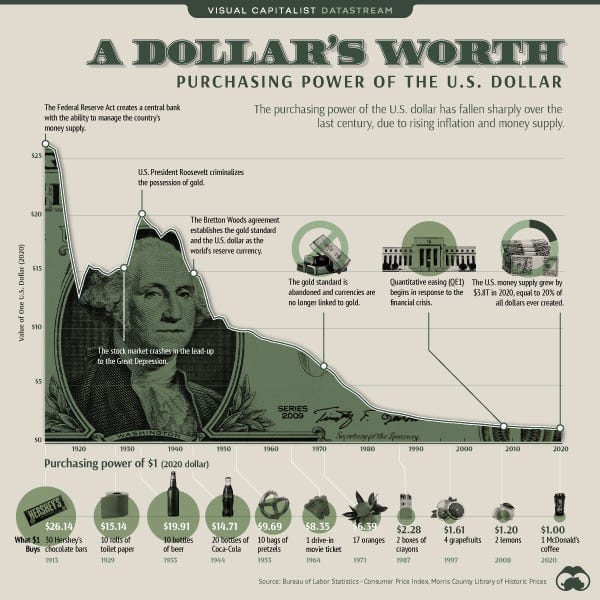
We rarely stop to ask what gives that dollar value, why its purchasing power continually declines, or how we arrived at a system where governments can create trillions of new dollars without producing trillions of dollars of new goods and services.
To understand where we may be headed, we first need to understand how we got here.
Money and Currency Are Not Exactly the Same Thing
Before getting into monetary history, there is an important distinction to make.
For something to function effectively as currency, it generally needs several characteristics.
It must work as a medium of exchange, allowing us to trade goods and services.
It should function as a unit of account, giving everyone a common way to measure value.
It needs to be durable, portable, divisible, and fungible.
Gold meets those requirements remarkably well.
But gold historically possessed another characteristic that governments have found much harder to replicate:
Scarcity.
You cannot create millions of ounces of gold with the push of a button.
It requires capital, labor, equipment, energy, and time to extract additional supply from the ground.
That scarcity helped gold function not only as currency but also as a store of value.
And that distinction becomes critical.
Because storing value means being able to move purchasing power through time.
You work today, save part of what you earn, and expect those savings to allow you to consume something in the future.
But what happens when the currency you are saving continually loses purchasing power?
Suddenly, simply saving is no longer enough.
You are forced to become an investor merely to avoid moving backward.
That is one of the fundamental problems created by modern fiat currency.
When Paper Represented Something Real
For much of monetary history, paper currency was not supposed to be valuable on its own.
It represented a claim on something else.
Gold.
Think about a dry-cleaning receipt.
You drop off your clothes and receive a paper ticket. Nobody believes the ticket itself is the valuable asset. It simply represents your right to retrieve the clothes being held for you.
Gold-backed currency operated in a similar way.
The paper was convenient.
The gold was the underlying money.
At one point, American currency explicitly reflected this relationship. Paper dollars represented a legally redeemable claim on gold.
But maintaining that system placed an important constraint on government:
You could not continually create claims on gold without eventually being asked to produce the gold.
That discipline became increasingly inconvenient as government spending expanded.
War Changes the Monetary Equation
World War I represented an enormous fiscal burden for the countries involved.
Governments needed to finance military operations on a scale that ordinary taxation could not easily support.
Gold redemption became a problem because governments wanted to spend more currency than their gold reserves allowed.
So many countries suspended gold convertibility.
This is an important recurring theme throughout monetary history.
Sound money restricts what governments can finance.
Fiat money removes much of that restriction.
After the war, the monetary system remained deeply unstable. The United States eventually responded during the Great Depression with one of the most dramatic monetary changes in American history.
In 1933 and 1934, the Roosevelt administration severely restricted private monetary gold ownership and changed the relationship between Americans, the dollar, and gold.
The government subsequently revalued gold from $20.67 to $35 per ounce.
Consider what that meant.
Citizens had surrendered gold at one price, and the government then changed the dollar price of that same gold.
The monetary relationship had fundamentally changed.
But gold had not disappeared from the global system.
That would come later.
Bretton Woods Makes the Dollar the Center of the World
World War II dramatically reshaped the global economy.
While Europe and much of the world suffered enormous destruction, the United States emerged with an extraordinarily powerful industrial base and a massive share of global gold reserves.
The new monetary system created after the war reflected that strength.
Under the Bretton Woods system, foreign currencies were linked to the U.S. dollar, while the dollar remained convertible into gold for foreign governments at $35 per ounce.
This effectively put the dollar at the center of the global monetary system.
It was an extraordinary privilege.
But it also created temptation.
The United States could issue dollars that the rest of the world needed for trade and reserves.
Over the following decades, Washington dramatically expanded spending.
There was the Korean War.
Then Vietnam.
Then President Lyndon Johnson's Great Society programs.
More dollars began circulating throughout the world.
Eventually, foreign governments began asking a simple question:
Does the United States actually have enough gold to honor all of these dollar claims?
France was among the countries that began exchanging dollars for American gold.
Other countries followed.
America's gold reserves declined.
The system was facing what was essentially an international run on the dollar.
Something had to give.
August 15, 1971
President Richard Nixon chose the dollar.
On August 15, 1971, Nixon announced that the United States would suspend the dollar's convertibility into gold.
It was presented as temporary.
It wasn't.
The final link between the dollar and gold had effectively been severed.
The modern fiat-dollar era had begun.
For the first time, the global monetary system was centered on a reserve currency that was no longer redeemable for a fixed quantity of gold.
The dollar's value would now depend primarily on government authority, economic power, taxation, financial markets, and—perhaps most importantly—confidence.
That changed the rules.
Government deficits were no longer ultimately restricted by available gold reserves.
Money and credit could expand far beyond the limitations imposed by a physical monetary asset.
And expand they did.
What Changed After 1971?
The 1970s quickly demonstrated one of the dangers.
America experienced severe inflation combined with stagnant economic growth.
By 1980, inflation had moved above 13%.
Federal Reserve Chairman Paul Volcker eventually responded by aggressively raising interest rates, with the federal funds rate moving above 20% at points.
It was painful.
But it restored confidence in the dollar and broke the inflationary spiral.
The larger monetary experiment, however, continued.
And the decades that followed produced another important transformation.
Assets increasingly became the preferred store of value.
If cash continually loses purchasing power, people naturally search for alternatives.
Stocks.
Real estate.
Businesses.
Commodities.
Gold.
Anything with the potential to appreciate faster than the currency depreciates.
That creates an enormous divide between people who own appreciating assets and those who depend primarily on wages and cash savings.
When asset prices rise dramatically, the wealthy appear to become dramatically wealthier.
But someone earning a salary may experience the same monetary environment very differently.
Their house becomes more expensive.
Education becomes more expensive.
Healthcare becomes more expensive.
Rent becomes more expensive.
And the cash sitting in their bank account purchases less.
This is one reason understanding the monetary system is so important when discussing inequality.
The conversation cannot simply be about wages or tax rates.
We also have to ask what is happening to the measuring stick itself.
Every Crisis Seems to Produce the Same Solution
Consider the major financial crises of the modern era.
The dot-com bust.
The Global Financial Crisis.
COVID.
Each crisis was different.
But policymakers repeatedly reached for variations of the same tools:
Lower interest rates.
Create liquidity.
Increase government borrowing.
Expand deficits.
Support asset markets.
And when new money and credit enter the financial system faster than the production of goods and services expands, there are consequences.
The dollar may still say $1 on its face.
But what that dollar buys can steadily decline.
That is currency debasement in the modern world.
You don't need someone to physically remove gold from a coin.
The same outcome can occur when the supply of currency and credit continually expands.
The Real Foundation of Fiat Currency Is Confidence
A fiat system can function for a very long time.
The dollar remains supported by the size of the U.S. economy, deep capital markets, taxation, American institutions, military and geopolitical power, and its central role in global finance.
But beneath all of those factors lies something far less tangible:
Trust.
People accept dollars because they expect somebody else will accept those dollars tomorrow.
Foreign governments hold dollar assets because they believe those assets will preserve enough value to justify holding them.
Investors purchase Treasury debt because they expect the United States to honor its obligations.
That confidence is incredibly powerful.
But history tells us it should never be taken for granted.
Today, the United States faces enormous federal debt, persistent deficit spending, rising interest costs, and political resistance to significantly reducing government expenditures.
That does not mean the dollar disappears tomorrow.
It does mean investors should understand the trajectory.
Because monetary systems rarely fail because somebody announces that the system has failed.
They deteriorate gradually as confidence weakens.
Then sometimes, seemingly all at once, behavior changes.
History Has Seen This Movie Before
The details differ from one civilization to another, but the larger pattern has appeared repeatedly.
A society begins with relatively sound money.
Prosperity grows.
Government obligations expand.
Political and military ambitions grow with them.
Debt rises.
The currency is eventually debased to finance promises that cannot easily be funded through taxation alone.
Purchasing power declines.
Citizens begin looking for alternatives.
Confidence in the currency erodes.
And tangible monetary assets reassert their importance.
Ancient empires did it by reducing the precious-metal content of their coins.
Modern governments have far more sophisticated tools.
But economically, the principle is similar.
Debasement allows governments to spend purchasing power they did not first have to tax directly from the population.
The cost arrives later through declining purchasing power.
Why Sound Money Still Matters
Sound money is not about nostalgia.
It is about incentives.
A monetary system that makes currency creation difficult imposes discipline on governments, banks, investors, and individuals.
It forces trade-offs.
If government wants to spend dramatically more, someone must actually finance that spending.
If a war becomes extraordinarily expensive, citizens feel the cost more directly.
If an investment is unproductive, continually creating cheaper credit cannot disguise the mistake forever.
Sound money forces reality back into the equation.
And that is ultimately why understanding monetary history matters.
\
You can disagree about whether gold, Bitcoin, another monetary asset, or some future system provides the best solution.
The market should ultimately decide that.
But we should at least understand the system we're using today.
Because if you spend decades building wealth without understanding the currency in which that wealth is measured, you are ignoring one of the biggest variables affecting your financial future.
The dollar in your bank account may still have the same number printed on it ten years from now.
The more important question is:
What will it buy?
Want to Go Deeper?
This is the condensed version of my full Sound & Sovereign analysis.
In the full article, I go much deeper into the monetary history behind today's system, including:
The difference between money and currency
How the Federal Reserve changed the monetary system after 1913
FDR's 1930s gold policies
How Bretton Woods made the dollar the world's reserve currency
The international run on U.S. gold reserves before 1971
What changed after Nixon closed the gold window
The relationship between fiat currency, asset prices, debt, and wealth inequality
The seven-stage historical cycle from sound money to monetary debasement
Why gold and other scarce monetary assets become increasingly important as confidence in fiat currency declines
Understand the System. Protect What You've Built. Preserve Your Sovereignty.
Join thousands of readers exploring money, markets, monetary history and sound money.
ABOUT
FREE MINDS.
FREE MARKETS.
SOUND MONEY.


