
It’s Not Late-Stage Capitalism. It’s the Cantillon Effect.
Why the people closest to newly created money benefit first—and everyone else pays later.
When people look at rising inequality, unaffordable housing, soaring asset prices, and declining purchasing power, they are increasingly told they are witnessing the failures of “late-stage capitalism.”
But there is a problem with that argument:
What we have today is not a free market monetary system.
At the center of the modern financial system is a central bank with the ability to create new money, manipulate interest rates, and inject liquidity into specific areas of the financial system.
And when new money enters the economy, it does not reach everyone equally.
That is where the Cantillon Effect becomes important.
New Money Has a First Recipient
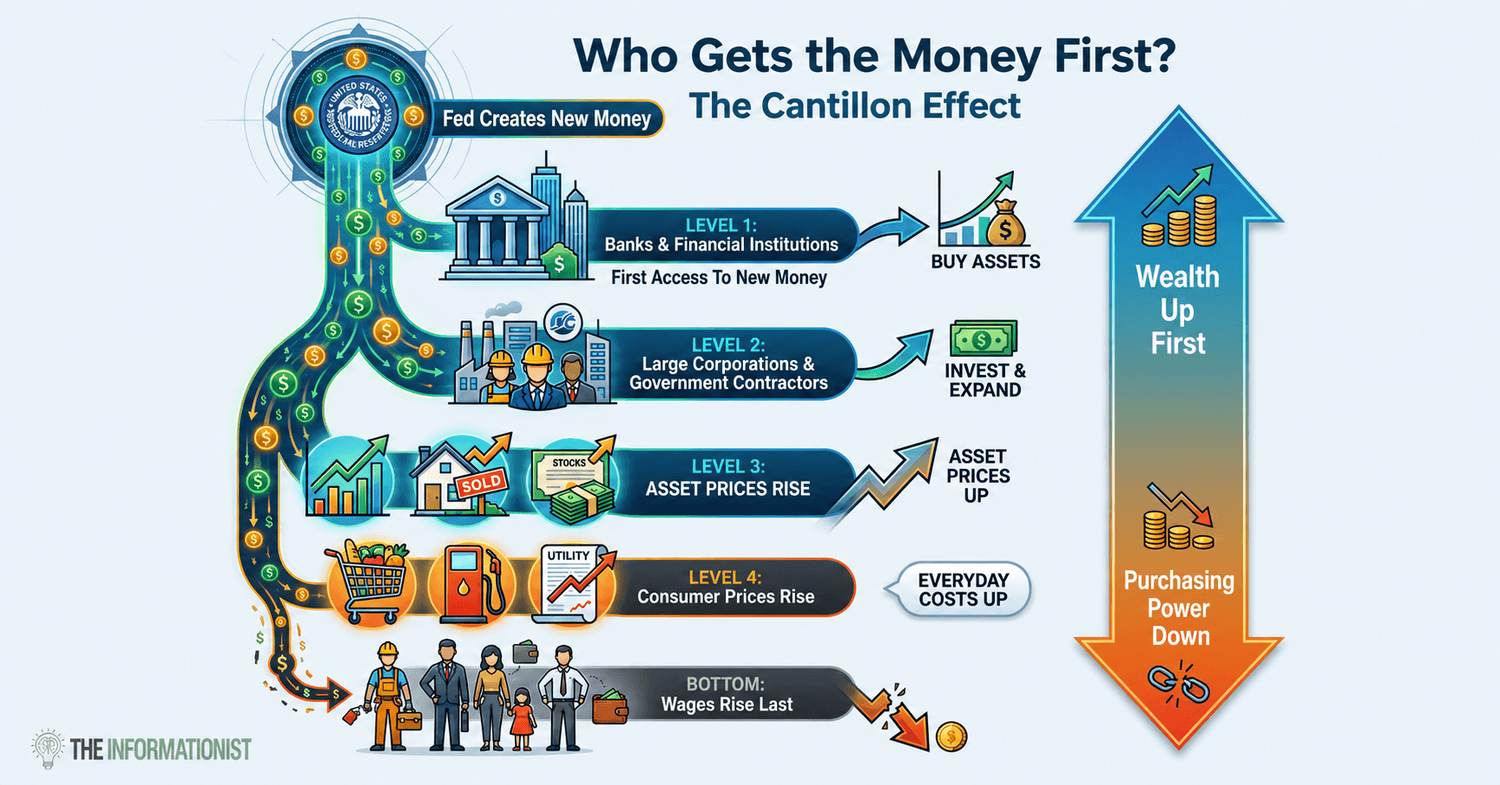
The Cantillon Effect describes a simple but powerful idea:
New money does not enter the economy evenly.
Someone receives it first.
When the Federal Reserve creates liquidity through programs such as quantitative easing, that money initially enters the financial system through banks, primary dealers, financial institutions, and capital markets.
Those closest to the source of new money can deploy capital before prices have fully adjusted.
The money then moves outward through the economy.
By the time it reaches ordinary workers, savers, and consumers, asset prices and eventually consumer prices may already have increased.
That distinction matters.
Because inflation is not simply about the total amount of money created.
It is also about who receives that money first.
Follow the Money
In simplified form, quantitative easing works something like this:
The Federal Reserve creates bank reserves and uses them to purchase assets such as Treasury securities or mortgage-backed securities.
Financial institutions receive additional liquidity.
Capital begins searching for returns.
Stocks, bonds, real estate, and other financial assets can rise as more money competes for those assets.
But someone living primarily on wages does not receive an equivalent increase in wealth simply because the stock market or housing market rises.
In fact, they may experience the opposite.
The house they wanted to purchase becomes more expensive.
Rent increases.
Food costs more.
Their savings purchase less.
Meanwhile, someone who already owned significant financial assets may have watched their net worth rise dramatically.
That is why monetary inflation can have vastly different effects depending on where someone sits within the financial system.
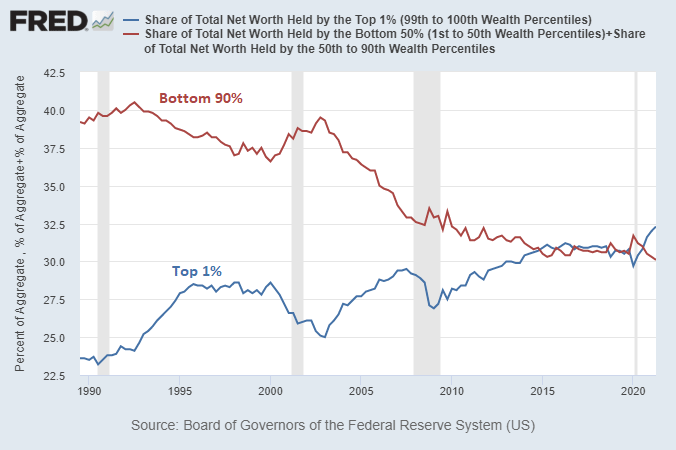
2008 and COVID Made the Mechanism Visible
The aftermath of the 2008 financial crisis demonstrated how powerful monetary intervention could become.
The Federal Reserve dramatically expanded its balance sheet while interest rates remained historically low. Financial assets subsequently experienced an enormous recovery.
Then came COVID.
The monetary and fiscal response was unprecedented.
Money supply surged, liquidity flooded the financial system, financial assets climbed rapidly, and eventually Americans experienced the highest consumer inflation in decades.
For someone who already owned substantial stocks, real estate, or businesses, rising asset values could partially offset the decline in the dollar's purchasing power.
For someone living paycheck to paycheck?
There was no such protection.
Their grocery bill went up.
Their rent went up.
Their energy costs increased.
And the dollars sitting in their savings account purchased less.
This is why simply blaming “capitalism” for rising wealth inequality misses one of the most important forces operating underneath the system.
This Is Not How Free Markets Are Supposed to Work
Free markets depend on price discovery.
Interest rates are prices.
Capital has a price.
Risk has a price.
Money itself communicates economic information.
When those signals are manipulated by central authorities, investment decisions begin responding not merely to genuine supply, demand, savings, and productivity—but to monetary policy.
That creates an economy increasingly dependent upon cheap credit, rising asset prices, government spending, and continued intervention.
Then, when the consequences appear—asset bubbles, inflation, inequality, speculation—the same system is blamed on capitalism.
But centralized manipulation of money is not a free-market mechanism.
It is intervention in one of the most important prices in the entire economy.
Understanding Money Changes How You See the Economy
If you want to understand why asset prices have exploded, why purchasing power keeps declining, and why monetary policy increasingly seems to benefit those who already own financial assets, you have to understand how money actually enters the economy.
That means understanding the Federal Reserve.
Quantitative easing.
Bank reserves.
Asset inflation.
The Cantillon Effect.
And the relationship between monetary policy, fiscal policy, and financial markets.
Because before we can debate whether capitalism has failed, we should first ask a much more fundamental question:
Are we actually operating under a free-market monetary system at all?
Want the Full Breakdown?
In the full Sound & Sovereign article, I go deeper into:
How quantitative easing actually works
Where newly created Federal Reserve liquidity enters the financial system
Why asset owners frequently benefit first
What happened after 2008
What changed during COVID
How monetary intervention contributes to wealth concentration
Why sound money is inseparable from genuinely free markets
Understand the System. Protect What You've Built. Preserve Your Sovereignty.
Join thousands of readers exploring money, markets, monetary history and sound money.
ABOUT
FREE MINDS.
FREE MARKETS.
SOUND MONEY.


